Missed Call Text Back After Hours: Win Bookings While Your Business Is Closed
It is 8pm. Your business closed at 5. A potential customer finds your number, calls, and hears ringing that goes nowhere. They hang up, scroll to the next business on the list, and call them instead.
That is the after-hours problem. During the day, a missed call is a timing issue. After hours, a missed call is a lost lead, because the caller has no reason to wait until morning. They have a problem now, and the next business that answers wins.
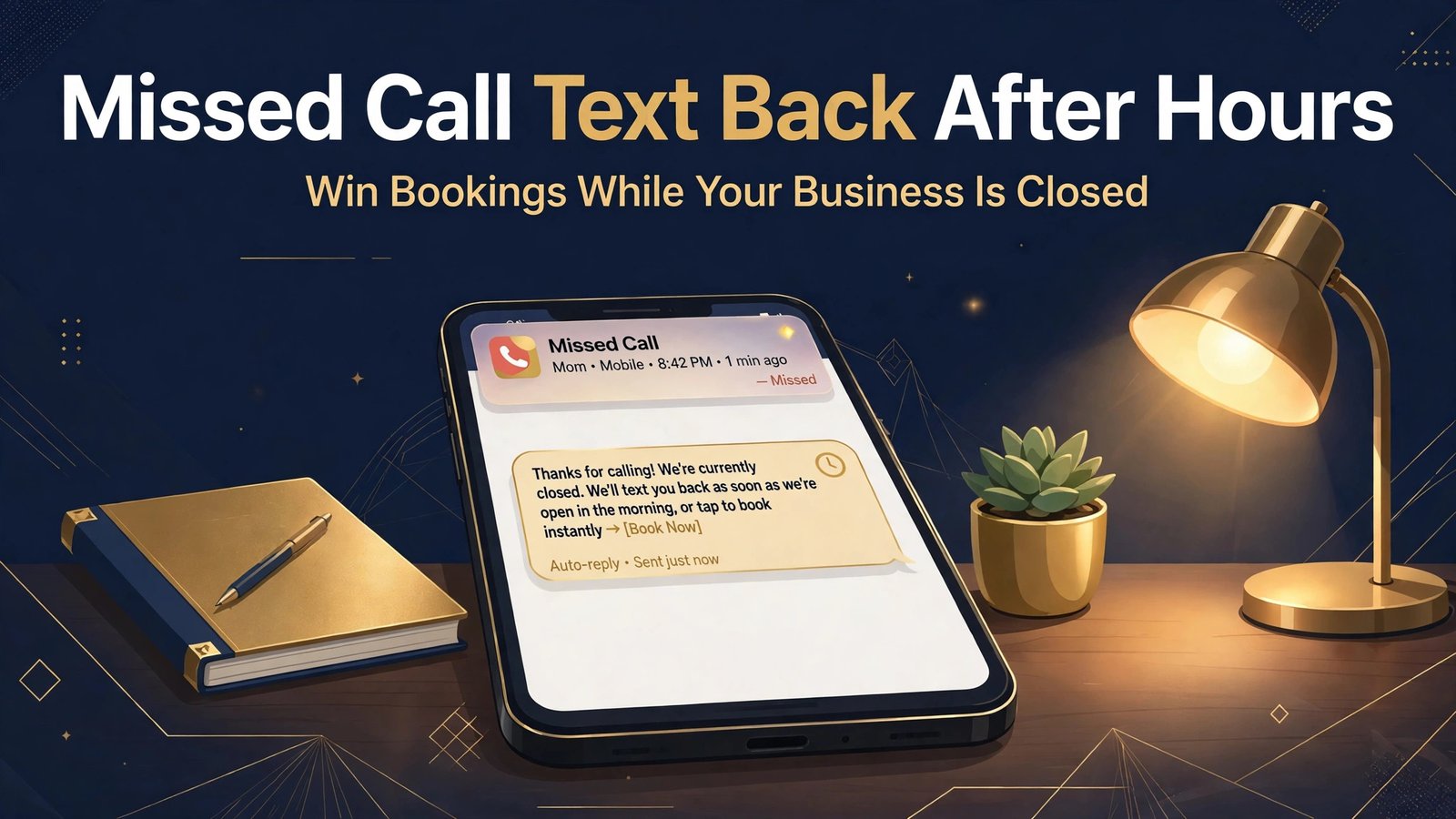
A missed call text back fixes this. When a call goes unanswered outside your working hours, the caller gets an automatic text within seconds. It tells them you received their call, when you will get back to them, and how to book or leave a message right now.
Why After-Hours Calls Are Different
Most businesses set up one missed call text for the whole day. That is a start, but an after-hours caller needs a different message, because their situation is different.
During the day, a caller expects a callback soon, so a simple "sorry we missed you" works. After hours, that same message is a dead end: the caller knows it means tomorrow, maybe, and has no idea whether you even saw the call.
An after-hours text has three jobs the daytime version does not. It must confirm that the business actually saw the call, give a clear time when a real person will respond, and offer something the caller can do right now, such as booking a slot or leaving a short message. Without those three things, the text is just a polite voicemail in written form, and voicemail does not win customers.
What to Say in an After-Hours Missed Call Text
The message should be short, honest, and useful. Three sentences are enough. Here is a structure that works for most small businesses:
- Acknowledge the call. "Hi, thanks for calling [business name]. We are closed right now, but we received your call."
- Say exactly when you will respond. "We will call you back tomorrow at [time], when we open." A vague "soon" is worse than a specific time, because a specific time is a promise the caller can hold you to.
- Offer one action they can take now. "If you would like to book a time, here is our booking link: [link]. Or just reply to this message and tell us what you need."
That third line is where the booking happens. A caller who books a slot at 9pm is a booked customer, even though nobody in your office was awake.
Leave out the sales pitch. Do not list services, ask the caller to fill in a form at 9pm, or pretend someone is available when nobody is. Callers forgive a business that is closed. They do not forgive one that pretends otherwise and then goes quiet.
How to Set Up an After-Hours Missed Call Text Back
This is a short project. You do not need a new phone system, and you do not need a developer.
Step 1: Use a business number that can send texts. The text should come from the number the caller just dialled. If your landline cannot send SMS, move your business number to a system that can, such as GoHighLevel, before you build anything else. A text from an unfamiliar number confuses people and kills replies.
Step 2: Define your business hours in the system. Set your opening hours once, and let the system choose the right message. Most tools, including GoHighLevel, let you build this as a simple rule: missed during business hours, send the daytime message; missed outside them, send the after-hours message.
Step 3: Write two messages, not one. The daytime message says you will call back shortly. The after-hours message says when you open, when you will respond, and offers the booking link. Test both by calling your own number once during the day and once after closing.
Step 4: Decide who handles the morning replies. An after-hours text starts conversations that land overnight. When your team opens in the morning, those replies should be the first thing they work through, before email and before new calls. A reply that waits until lunch is a lead that has had all morning to book elsewhere.
Step 5: Log every missed call in your CRM. Every missed call and every reply should land in your CRM with the caller's number attached, so nothing depends on someone remembering a phone's call history.
What to Do With the Replies in the Morning
The automation did its job overnight. The morning is where the booking is won or lost.
Start with the callers who replied. They told you what they need, so call them back in the order they replied, and open with what they said: "Hi, you texted us last night about a boiler repair, I am calling to book you in."
Then work through the callers who did not reply. A short morning text works well: "Good morning, we saw your call last night. Are you still looking for [service]? We have slots today at [time]." A call that gets no answer and no follow-up is a lead thrown away.
Check the overnight numbers once a week: how many calls came in after hours, how many replied, how many booked. Those three numbers tell you whether your message is working.
Mistakes That Undo a Good Setup
A missed call text back is simple, which is why the mistakes are simple too.
The first mistake is sending the same message at 2pm and 2am. A caller at 2am does not need a booking link for tomorrow morning at 9, they need to know you saw them and when to expect you. Match the message to the hour.
The second mistake is sending the text but never checking the replies. An unanswered reply is worse than no text at all. If nobody owns the replies, do not turn the automation on.
The third mistake is making the first text a sales pitch. "We missed your call! Book now and get 20 percent off!" reads like spam. Help first, sell later. The booking link is enough.
The fourth mistake is forgetting holidays and closures. If you close for a week, your after-hours message should say so, and say when you return.
FAQ
Does a missed call text back work for any type of business? Yes, if customers call you. It works best for service businesses where a call is the first step toward a booking, such as clinics, salons, trades, dental practices, and estate agents.
Will customers think the text is spam? No, as long as it comes from the number they just called and sounds like a real business. A short, plain message from your business number is clearly connected to the call they made seconds earlier.
Do I need GoHighLevel to set this up? No, but it is one of the simplest tools for it. Any system that can detect a missed call and send an SMS can do the job.
What if a caller replies at midnight? Nothing happens until the morning, and that is fine. The text already told them when you will respond, so they are not waiting by the phone. Your morning routine is to answer those overnight replies first, in order, before anything else.
Should I use an AI voice agent instead? An AI voice agent answers the call itself, which is a step beyond a text back. A missed call text back is the simpler, cheaper starting point, and many businesses run both: the voice agent answers when it can, and the text back catches anything it misses.
Start With Tonight
You do not need to rebuild your phone system to stop losing after-hours leads. You need one automation, two messages, and a morning habit of answering the replies first.
Set it up today, test it by calling your own number tonight, and check tomorrow morning how many callers replied. That first morning will tell you how many customers your business was losing while it slept.
If you would like help setting this up for your business, book a call at mrbilalali.com/book and we will build it together.